Copyright basics for AI-made images and text
Official guidance in the United States and Korea says AI output made only from a prompt is unlikely to be protected by copyright. This guide explains the standards in both countries and what to check before you use AI output.
한국어English
ON THIS PAGE
- 01At a glance
- 02An analogy: a made-to-order art shop
- 03Three questions to separate first
- 04The United States: the Copyright Office standard
- 05Korea: the standard of the Ministry of Culture, Sports and Tourism and the Korea Copyright Commission
- 06When you wrote a very good prompt
- 07Terms of service: what the receipt says and what it does not
- 08Checklist before using AI-made pictures and text
- 09Summary
- 10Read next
- 11References
Based on: U.S. Copyright Office guidance and reports (2023, 2025), a U.S. federal appeals court decision (2025), guides from Korea's Ministry of Culture, Sports and Tourism and the Korea Copyright Commission (2023, 2025), and terms of service (OpenAI, Higgsfield). Checked in September 2026.
Before you read: This guide is general information that explains official sources in plain words. It is not legal advice. Copyright rules differ by country and keep changing. For decisions about a real business or dispute, get advice from a lawyer or another expert, or from a consultation with the Korea Copyright Commission.
Official guidance in the United States and Korea points in the same direction: "output that AI made on its own from just a prompt is unlikely to be protected by copyright, and only the parts a person creatively worked on can be protected." Even if a service's terms say "the output belongs to the user," that does not mean copyright exists. This guide explains this difference and lists what to check when you use pictures and text made with AI.
How AI makes pictures and videos is covered in How AI image generation works and how to write good prompts and An introduction to AI video generation.
At a glance
| Item | Short summary |
|---|---|
| Copyright in an AI picture made only from a prompt | Official guidance in both the U.S. and Korea says it is "unlikely" |
| Copyright in a work that used AI | Parts a person created directly can be protected |
| "The output belongs to the user" in the terms | Means the service hands over the rights it has. It cannot create a copyright the law does not recognize |
| Positions in other countries | They differ by country |
| What to do first | Check the terms of the service you use, and keep a record of how you made the work |
An analogy: a made-to-order art shop
Making a picture with AI is like ordering a picture from a made-to-order art shop.
- The prompt is the order form you hand to the shop. You write what you want, such as "a beach at sunset, watercolor style."
- The AI is the machine painter that takes the order form and paints. It paints what the form says, but the machine painter decides where and how the brush goes.
- Your brushwork is the part where you paint over the picture you received, fix it, or pick and arrange several pictures yourself.
- The terms of service are the receipt the shop gives you. The shop can write that it hands its rights over to the customer, but it cannot create rights it never had.
Compare this with ordering a picture from a human painter. In that case, the author (the person who made the work) is the painter who actually painted it, not the person who ordered it. The Korea Copyright Commission's guide also says that "a person who only gave an idea or theme" or "a person who paid to commission the work" is usually not seen as the author. But an AI painter is not a person, so it cannot be an author. That is why an AI picture made from an order form alone easily becomes a picture with no author at all.
Three questions to separate first
Discussions of copyright in AI output often get mixed up. Splitting them into three questions makes them less confusing.
- Does copyright exist in my output? The law decides this. See the U.S. and Korean standards below.
- What does the service allow me to do? The terms decide this. Whether you may use it commercially, and how the service uses your material, are covered here.
- Does my output infringe someone else's rights? This is about whether it clashes with other people's rights, such as existing works, trademarks, or the faces of real people.
The answers to the three questions can differ. For example, the terms may allow commercial use (question 2), but if no copyright exists in the output, it is hard to stop others from copying it exactly (question 1), and if it looks like a famous character, it may actually cause problems (question 3).
The United States: the Copyright Office standard
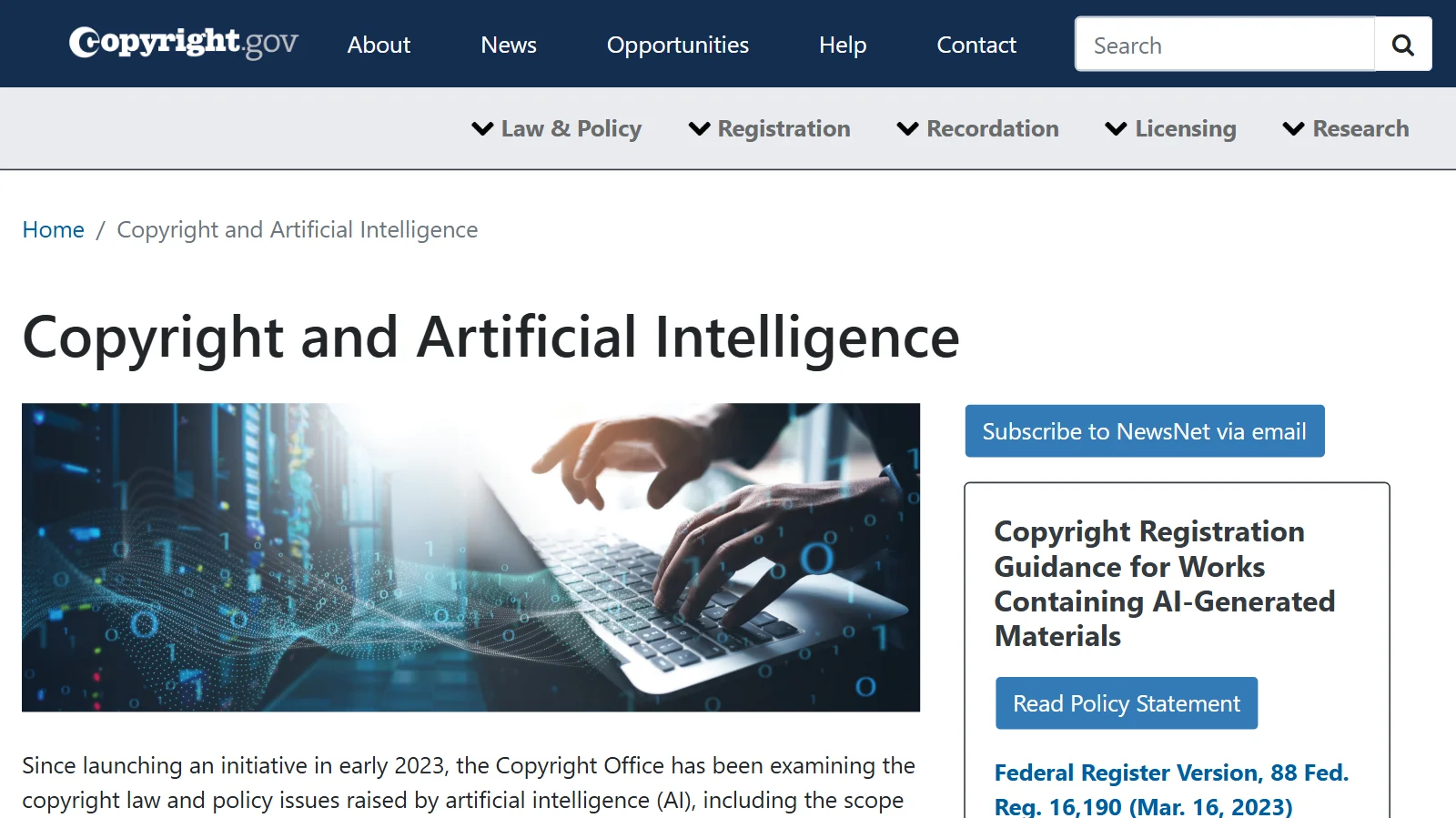
The U.S. Copyright Office keeps a separate collection of official materials on AI. Two documents set the standard.
The March 2023 registration guidance states that copyright registration requires human authorship. The guidance says that when a user only gives a prompt and the AI produces complex text, images, or music, the technology, not the user, decided the expression. It explains that prompts "function more like instructions to a commissioned artist." This is the same idea as the art shop analogy in this guide. In an example from the guidance, if you ask for "a poem about copyright law in the style of William Shakespeare," you will get text that looks like a poem, but the technology decides the rhyme, the words, and the structure.
The January 2025 report (Part 2, Copyrightability) set out this position.
- A work is protected only when a person determined enough of the expressive elements, and giving a prompt alone is not enough.
- Protection is possible when a human-made work is still visible in the output, or when a person creatively arranged or modified the output.
- Using AI as a tool that assists creation, or including AI-generated material in a larger human-made work, does not block protection.
The courts point the same way. On March 18, 2025, in Thaler v. Perlmutter, the U.S. Court of Appeals for the D.C. Circuit held that refusing to register a picture that listed AI as its sole author was correct. The decision says the Copyright Act of 1976 requires every work to be made by a human in the first instance.
To register a work that includes AI in the United States, the guidance says you must disclose that it includes AI-generated parts and briefly describe what the human contributed. AI-generated parts that are more than minor must be listed and excluded in the "Material Excluded" field of the application. If you already registered and left this out, the guidance says to correct it with a supplementary registration, and it states that if you do not, you risk losing the benefits of the registration.
Korea: the standard of the Ministry of Culture, Sports and Tourism and the Korea Copyright Commission
In Korea, the Ministry of Culture, Sports and Tourism and the Korea Copyright Commission published a "Generative AI Copyright Guide" in December 2023, and in June 2025 they released a "Copyright Registration Guide for Works Using Generative AI" (both in Korean). The registration guide states that it is based on the Copyright Act and case law as of June 2025 and may change with amendments to the law or new court decisions.
The guide starts from the definition in Article 2 of the Copyright Act. A work is a creative production that expresses human thoughts or emotions. So it splits AI output into two kinds.
| Kind | Meaning | Registration |
|---|---|---|
| Work using generative AI | Uses AI as a tool but includes a person's creative contribution | Possible (effective only for the human-contributed parts) |
| AI output | Made by AI without a person's creative contribution | Not possible |
The guide gives three cases where a human contribution is recognized.
- When you feed a work you made (for example, a sketch you drew yourself) into the AI and its creativity shows in the output
- When you creatively edit, add to, or remove from the AI output
- When there is creativity in selecting, arranging, and organizing pieces of AI output
On the other hand, minor touches such as fixing typos, slight resizing, or simple color changes are not seen as creative contributions, even if a person made them. The guide also includes a case where registration was refused for a work that combined two AI pictures and applied simple corrections.
Here are the guide's registration examples as a table.
| Example | Where the registration takes effect |
|---|---|
| A comic where a person wrote the text and AI drew the pictures | Only the text |
| A picture where AI only colored a sketch drawn by a person | Only the sketch |
| A work where a person creatively selected and arranged several AI pictures | Only the way they were selected and arranged (a work made by selecting and combining material like this is called a compilation). Not each individual picture |
| A picture a person drew from scratch after only getting an idea from AI output | The whole new picture |
The guide's FAQ also has two sentences worth noting. One is a warning that deliberately registering AI output as if it were your own work can be punished as false registration. The other is advice that recording your process, for example on video, becomes important evidence in registration or disputes. In other words, keep records that show where your brushwork was.
When you wrote a very good prompt
Many people ask whether it changes things if they rewrote a prompt dozens of times. The Korean guide says the same prompt does not give the same result every time, so entering a prompt alone is unlikely to be recognized as a creative contribution. In art shop terms, no matter how detailed your order form is, the machine painter is the one holding the brush.
However, the same guide notes that positions differ by country (as of June 2025, when the guide came out).
- United States: a prompt alone is unlikely to give enough control to make the user the author.
- Japan: looks at the length and content of the prompt, the number of generation attempts, and the process of choosing among several results, and leaves room to recognize a creative contribution.
- China: there is a court decision that recognized a creative contribution even when only a prompt was entered.
It adds that the text of a prompt itself can be a work if it is creative, but that does not mean the output from that prompt is creative too. A good order form can be your own writing, but that does not make the machine painter's picture your picture.
Terms of service: what the receipt says and what it does not
Most AI services have a clause about output in their terms. Here are two examples.
- OpenAI Terms of Use: to the extent permitted by applicable law, you retain your rights in the input and you own the output, and OpenAI assigns to you its rights, "if any," in the output. It also states that output may not be unique and other users may receive similar output.
- Higgsfield Terms of Use (version revised July 26, 2026): it does not claim ownership of input or output, but states that output may not be unique and other users may receive similar or identical output. It also says input and output may be used to train AI models (with an exception for enterprise agreements). An introduction to Higgsfield itself is in An introduction to Higgsfield.
The words to note here are "if any" and "to the extent permitted by law." Even if the art shop's receipt says "we give the customer all rights to the picture," nothing is passed on if the shop has no rights. The terms can give permission to use the output, but they cannot create a new copyright that the law does not recognize. And the clause saying "other people may get the same result" shows the reality that it is hard to keep your output to yourself.
Checklist before using AI-made pictures and text
The answer may differ by situation, so treat this as a reference.
- Read the terms: check whether commercial use is allowed, whether your input and output are used for training, and the clause on uniqueness of output.
- Avoid other people's rights: avoid requests that include real people's faces, famous characters, trademarks and logos, or the names of specific artists.
- Leave your brushwork: if protection matters, do not use the AI output as is. Edit, add to, and arrange it yourself.
- Record the process: keep your prompts, intermediate results, and the parts you changed in files or screen recordings.
- Be honest when registering: if you register copyright, list the AI-made parts and the parts you made separately.
- Check the latest guidance: the rules are changing, so check the latest guidance from official bodies again before important decisions.
Summary
| Art shop analogy | What it really means |
|---|---|
| Order form | The prompt. An order form alone is unlikely to make you the author (official U.S. and Korean guidance) |
| Machine painter | AI. It is not a person, so it cannot be an author |
| Your brushwork | The parts a person edited, added, selected, and arranged directly. Only these parts can be protected |
| Receipt | Terms of service. They give permission to use, but cannot create a copyright that does not exist |
| Scales that differ by country | Japan, China, and others leave room for different judgments. Check the latest guidance |
This guide is not legal advice. Before important decisions, read the original official sources below and get help from an expert.
Read next
- How AI image generation works and how to write good prompts
- An introduction to AI video generation: making videos from text and images
- An introduction to Higgsfield: how the image and video AI platform is organized, and the terms to check before using it
References
Rules and terms can change, so check the originals yourself.
- U.S. Copyright Office, Copyright and Artificial Intelligence (collection of AI materials) — https://www.copyright.gov/ai/
- U.S. Copyright Office, Copyright Registration Guidance: Works Containing Material Generated by Artificial Intelligence, 88 Fed. Reg. 16,190 (2023-03-16) — https://www.copyright.gov/ai/ai_policy_guidance.pdf
- U.S. Copyright Office, Copyright and Artificial Intelligence, Part 2: Copyrightability (2025-01-29) — https://www.copyright.gov/ai/Copyright-and-Artificial-Intelligence-Part-2-Copyrightability-Report.pdf
- U.S. Copyright Office, NewsNet Issue 1060 (announcement of Part 2) — https://www.copyright.gov/newsnet/2025/1060.html
- U.S. Court of Appeals for the D.C. Circuit, Thaler v. Perlmutter, No. 23-5233 (decided 2025-03-18, copy posted by the Copyright Office) — https://www.copyright.gov/ai/docs/court-of-appeals-decision-affirming-refusal-of-registration.pdf
- Korea Copyright Commission and Ministry of Culture, Sports and Tourism, Copyright Registration Guide for Works Using Generative AI (2025-06, in Korean) — https://www.copyright.or.kr/information-materials/publication/research-report/view.do?brdctsno=54253
- Ministry of Culture, Sports and Tourism press release on two guides covering copyright registration and dispute prevention for generative AI (2025-06-13, in Korean) — https://www.mcst.go.kr/site/s_notice/press/pressView.jsp?pSeq=21868
- Ministry of Culture, Sports and Tourism press release announcing the AI copyright guide (2023-12-27, in Korean) — https://www.mcst.go.kr/site/s_notice/press/pressView.jsp?pSeq=20743
- OpenAI, Terms of Use — https://openai.com/policies/row-terms-of-use/
- Higgsfield, Terms of Use (last revised 2026-07-26) — https://higgsfield.ai/terms-of-use-agreement